Fit to Be President
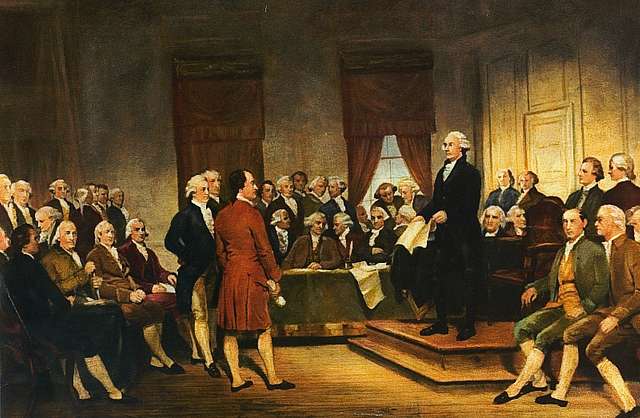
Washington at Constitutional Convention 1787 Painting by Gilbert Stuart
Donald J. Trump is not fit to be the President of the United States. This is not a unique feature of the man, as most people aren’t. Consequently, most people don’t end up in that position. In any case, what does qualify one to hold the most powerful executive position in the most consequential organization known to the world? According to the Constitution, the laughably low qualifications are being a natural‑born citizen, at least 35 years of age, and a minimum of 14 years of residency in the United States.
Might I introduce you to General George Washington of the Colony of Virginia? Born in 1732, Washington was a natural‑born subject of the British Crown. He served in the Virginia House of Burgesses, the lower house of the colonial legislature, and fought in British uniform in wars against other inhabitants of North America. “Citizens”; no, but the only true “Americans” to exist at the time.
By that standard, General Washington was not fit to be the President of the United States. Except, the qualification list I mentioned earlier does have a little clause. If you happened to be ”a Citizen of the United States, at the time of the Adoption of this Constitution,” however recently converted from British subject, you were good to go. That defeats the purpose, does it not?
The members of the Constitutional Convention were rightfully worried about foreign monarchs and schemers. They wrote in a loyalty test, but proceeded to puncture it immediately with a clause to grandfather themselves in. Washington and his peers were eligible, but future strangers were not. The bar has never been more than a loose anti‑foreign filter, a few demographic minimums, and a nod for the men already in the room.
Two centuries later, we talk about presidential “fitness” as if there were meant to be some richer standard hidden in the text, discoverable only after thorough debate, test, and strain. Unfortunately for us, there is not. The law cares about where you were born, how old you are, and how long you have lived in the country you aim to lead. It’s not quite a psychological evaluation. Everything actually argued about, from temperament and honesty to the most basic respect for our institutions, lives outside the documentation.
Whatever the Framers thought they were creating in Article II, what we live with now is a single human being at the apex of the largest military, surveillance apparatus, and bureaucracy that spans the planet. Before we keep shouting about who is or isn’t “fit” to sit in that chair, it is worth asking a more basic question: what, exactly, should that chair control?
The few lines in the Constitution about “executive Power” have swollen into a single person who can, by statute and practice, send troops into combat, reshape global relationships, influence economic markets, and decide which issues are urgent and which get quietly set aside. They nominate the judges who will interpret the Constitution for decades, and can grant pardons and reprieves for federal offenses.
It does not read like a job description. It reads like a list of methods that one person is allowed to use to bend reality, from their desk, to suit themselves. We have taken a head of state, armed them like a wartime commander, surrounded them with the loyalties of a partisan leader, and extended their reach like a chief global administrator. We have welded these powers together, handed them to one person, and given them a four‑year lease. Once installed, they aim that power back at the system. Tilting rules, resources, and attention in their favor, all but assuring the lease is renewed. With that much unilateral leverage over law, enforcement, and narrative, an incumbent does not just govern. They engineer the conditions of the political landscape. They shape who votes, what counts as fraud, and which cases get prosecuted. They determine reality by deciding which channels of information get amplified.
In that light, “fit to be president” starts to look less like a standard and more like a fantasy candidates can play to. Hiding in the dark beyond the cameras and interviews, they curate the perfect persona, artificially molded to meet expectations that are unrealistic. We are weighing individual psyches against an office that can move armies, markets, and borders by improvisation and impulse.If no person imaginable can reasonably be trusted with the modern powers of the presidency, as it actually exists, then “Who should we elect?” is already the wrong question.
■
Ryan Dawes, 2026
Kingsport, Tennessee